
How Have Sex with a Bearded Dragon: A Guide for Male and Female. Nearly all bearded dragon owners attempt to determine if their dragon is male or female at some point. It seems simple—until you start reading online tips.
Claims such as “males are bigger,” “only men turn their beards jet black,” and “arm waving indicates you have a female” are common. These are all unreliable methods of determining sex. I’ve seen males that were smaller than anticipated, as well as ladies with dark beards and assertive demeanor. People are unaware of how much those characteristics overlap.
The key to sexing a bearded dragon is timing and the anatomy near the base of the tail. The distinctions may be slight or undeveloped in very young dragons. However, if you know what to look for
Common Myths About Male vs Female Bearded Dragons
Once you’ve seen enough dragons, most of the physical and behavioral characteristics that are frequently used to determine the sex of a bearded dragon prove to be unreliable.
Size: Although healthy men and females may overlap in size, males are often described as being larger. Genetics, nutrition, and general husbandry have a significantly greater impact on growth than sex alone. A male raised in subpar conditions is readily outgrown by a well-fed female nurtured in optimum settings.
Head shape: Some keepers consider a larger or more “blocky” head to be indicative of a male. Though the difference is small and varies greatly, mature guys may grow significantly thicker features. In young dragons, it is particularly unreliable; several dragons that appear “male” at three months of age have later shown to be female.
Black beard displays: A darker beard is a sign of authority, stress, or territoriality. It is not exclusive to men. When they feel threatened, during a feeding competition, or even when they are startled by their reflection, females will become black.
Both sexes engage in arm waving and head bobbing, which are frequently classified as submissive (female) or dominant (masculine). Sex is not nearly as important as context, emotion, and surroundings. When kept next to another dragon, a female may head-bob with the same assertiveness as a male.
These characteristics shouldn’t be used to predict sex because of how much they overlap. Anatomical distinctions, not external behavior, are the basis for accurate sexing.
The Most Reliable Method — Checking for Hemipenal Bulges
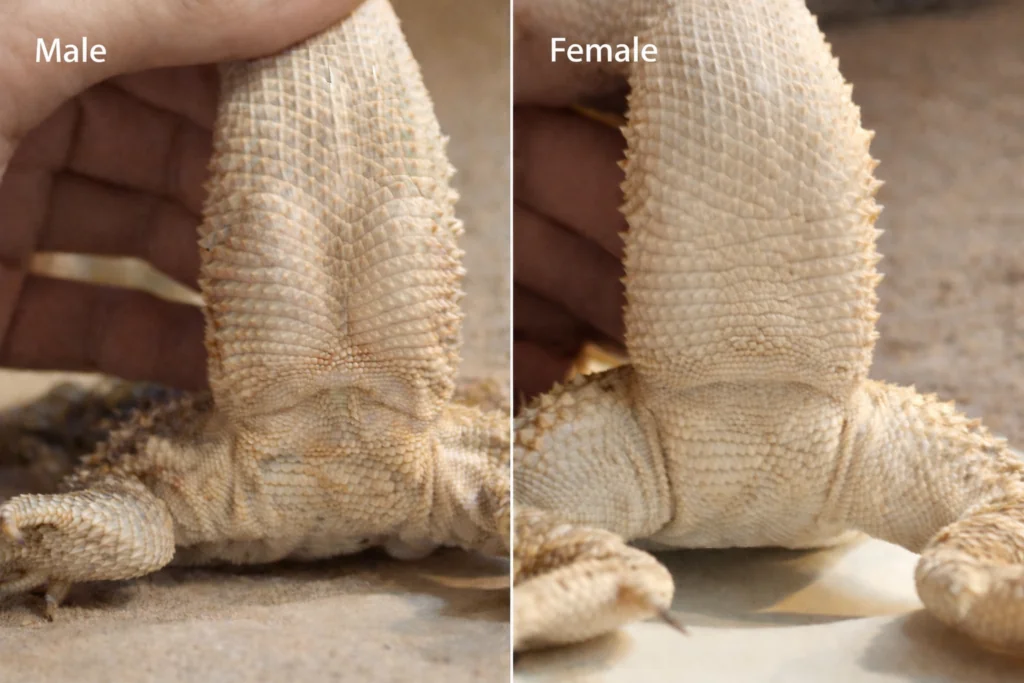
The best method for identifying the sex of a bearded dragon is to look for hemipenal bulges at the base of the tail. Males have these structures whereas girls do not, and if you know what you’re looking for, you can usually tell the difference.
Internal reproductive organs called hemipenes are located near the base of the tail in male bearded dragons. These show up as two separate bulges, one on each side of the tail base, slightly above the vent, when the tail is gently elevated. In contrast, the center line between them frequently appears somewhat flatter or indented.
Hemipenes are absent in females. They usually exhibit a single center bulge or a flatter, more uniform appearance in the same location rather than two distinct lateral bulges. A slight swelling may occur in some girls, but it won’t split into two separate sides.
To ensure safety, use one hand to fully support the dragon’s body while letting its legs rest. Gently raise the tail with your other hand. An angle of about 45 to 90 degrees is adequate; it doesn’t have to be very large. The tail should never be forced higher than it can move comfortably. Stop if you encounter opposition. Instead of stretching the tail, the objective is to slightly expose its base.
Lighting is important. The shape is easier to notice in a bright setting or in natural light. Instead of pressing or squeezing for definition, you are searching for contour and shadow along the sides of the tail base. Pressure is not necessary.
Clarity is influenced by age. Because males’ bulges are still developing, very young juveniles frequently seem female. The variations become more noticeable as the dragon matures, which usually takes several months. Waiting a few weeks and checking again is frequently more reliable than attempting to decipher minor early traits if the outcome appears ambiguous.
The most obvious sign of a male is still two distinct bulges at the base of the tail. A female is identified by a single center bulge or flat look.
Flashlight Method (Transillumination)
If the bulges aren’t clearly visible, a flashlight can sometimes make the structures easier to distinguish. This technique works best in a dim room using a bright, cool LED light.
Hold the dragon the same way described in the previous section: support the body fully in one hand, allow the legs to rest naturally, and gently lift the tail to a moderate angle — just enough to expose the base without forcing it.
Place the flashlight on the top (spine side) of the tail base, slightly above the rear, rather than depending solely on surface characteristics. The idea is to illuminate the internal structures by allowing light to enter the tissue from above without stretching or pushing the tail. Only leave the light on for a short while, and stay away from bulbs that emit perceptible heat.
Males typically have two darker or denser hemipenes on either side of the tail base, separated by a lighter middle line. In females, there are typically two distinct lateral shadows and more uniform light penetration.
This method is especially helpful in juveniles where external bulges are subtle. It is not foolproof. Tissue thickness, pigmentation, and the strength of the light all affect what you see. If what you’re seeing doesn’t feel definitive, it’s better to wait and reassess later than to overinterpret faint differences.
The flashlight method should confirm what you suspect — not replace the anatomical check.
Femoral Pores — A Supporting Clue
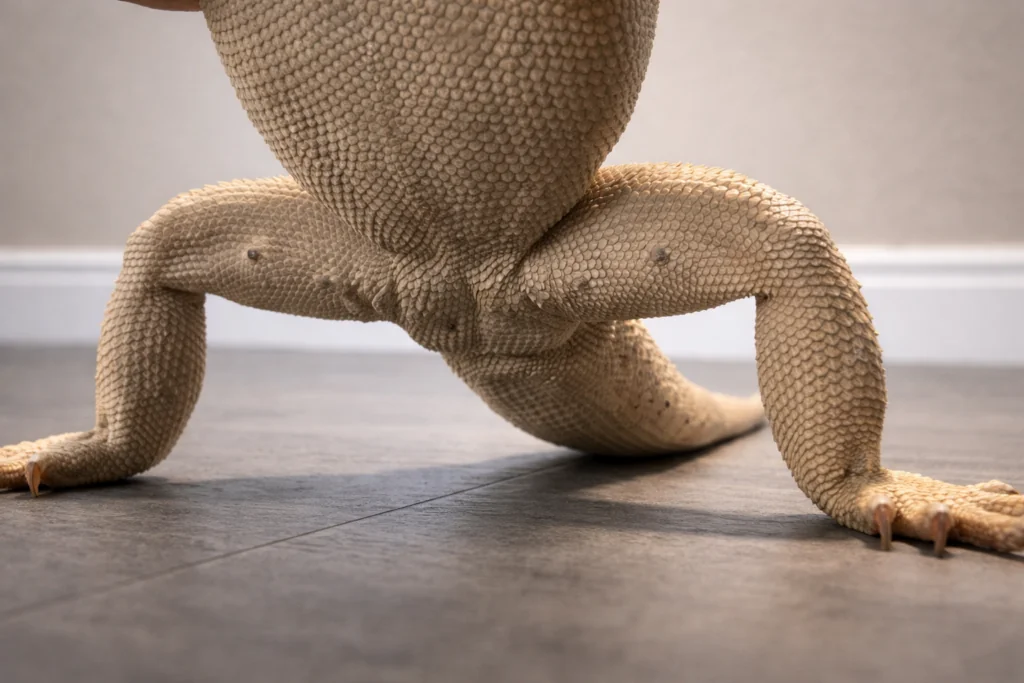

Femoral pores run in a row along the underside of each thigh. In mature males, they’re usually more obvious — larger, darker, and sometimes slightly raised. During breeding season, they may even look waxy or develop small plugs.
Women also have pores. They are usually flatter and smaller, and when viewed up close, they may appear more like weak pinpricks than distinct apertures. Although it isn’t noticeable in young people, that distinction becomes more apparent in fully developed adults.
The problem is that different people have different pore sizes. A young boy may not yet have many pores, whereas a healthy, fully grown female may. Femoral pores are therefore best utilized to reinforce what is already visible at the base of the tail.
They can support a conclusion, but they shouldn’t be the driving force behind it.
When Can You Tell for Sure?
Age matters — but development matters more.
Very young hatchlings often look female at first glance because the hemipenal bulges in males haven’t fully developed. In dragons under about three months of age, the differences can be faint enough to cause uncertainty, even when you’re looking carefully.
The difference normally becomes more apparent between three and six months. As the hemipenes grow, the male tail base thickens somewhat, making it simpler to distinguish between the two lateral bulges. By the time a dragon reaches a significant stage of juvenile development, sex can frequently be easily identified by visual inspection.
However, size by itself is not a guarantee. Some dragons mature slightly earlier or later than others due to differences in growth rates. It doesn’t hurt to wait a few weeks and double-check if the outcome looks dubious.
Over time, clarity gets better. Rarely does forcing a conclusion too soon work.
Things Not to Do
Pet owners shouldn’t use the technique known as probing, which can definitively identify sex. In order to determine internal depth, probing entails putting a specialized tool within the vent. It can be harmful if done improperly.
Probing is not necessary for the majority of owners. In almost every situation, the visual tail-base check is enough when paired with patience as the dragon grows.
A certified reptile veterinarian can carry out the treatment safely if complete certainty is needed, such as in a breeding situation.
There’s no need to jump to that degree of intervention in normal pet care situations.
A Realistic Viewpoint
The solution usually becomes clear once a dragon begins consistent juvenile growth. It’s not that you’re missing anything, but if you’re still unclear, it usually indicates that development hasn’t yet clarified the distinction.
Furthermore, daily care remains unchanged regardless of the outcome. Sex is not nearly as important as proper handling, lighting, food, and space.
Having this knowledge is beneficial. Simply put, there’s no reason to hurry.