
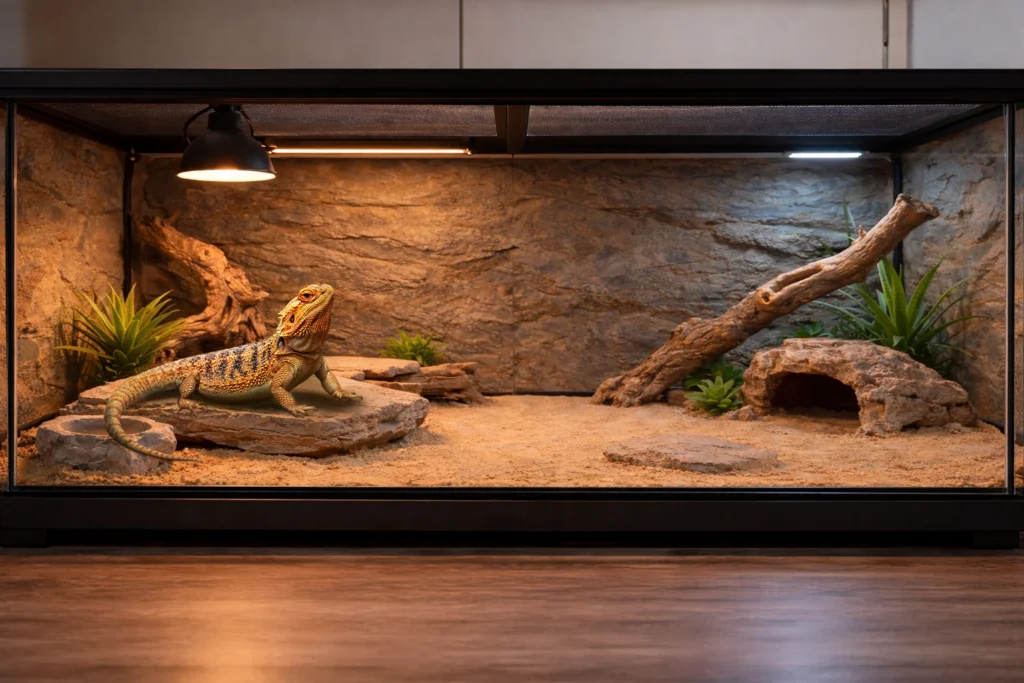
Bearded Dragon Tank Size Guide. A bearded dragon enclosure has to do more than hold the animal. It needs enough space for the dragon to move between a hot basking area, a cooler retreat, and shaded spots throughout the day.
Beardies don’t stay in one place for long. After warming up under the basking light, they often wander to the cooler side of the enclosure, climb onto a branch or rock, or settle briefly in a shaded area before returning to heat again. That constant movement is how they regulate their body temperature.
The problem is that enclosure size advice has changed over the years, and new owners often encounter a mix of older recommendations and newer husbandry standards. Gallon numbers alone rarely explain how the enclosure actually functions.
Once you understand how enclosure size affects heat gradients, lighting coverage, and the space a dragon uses during the day, choosing the right habitat becomes much clearer.
Minimum Enclosure Size for Bearded Dragons
When people ask what size enclosure a bearded dragon needs, the answer is often expressed in gallons. In practice, the more meaningful measurement is the floor footprint of the enclosure rather than the total volume.
For an adult bearded dragon, the commonly accepted modern minimum is an enclosure measuring 4 feet long by 2 feet wide by 2 feet tall. This footprint is often described as a 120-gallon equivalent, although the gallon rating itself is less important than the physical dimensions.
Those dimensions matter because they allow the enclosure to function as an environment rather than simply a container. A proper setup needs room for a distinct basking area, a cooler retreat zone, and open space between them where temperatures gradually change. In smaller tanks, those zones tend to collapse into one another, making it difficult to maintain a stable gradient.
Length is especially important. A longer enclosure separates the basking area from the cooler side, giving the dragon space to move between them throughout the day. Height plays a smaller role because bearded dragons are primarily terrestrial lizards that spend most of their time traveling across the ground and low structures rather than climbing vertically.
You may still encounter smaller tanks recommended in older care guides or pet store setups. Husbandry advice has gradually shifted as keepers gained more experience with UVB lighting and basking temperatures, and how beardies actually use their enclosure space. Today, the 4×2×2 enclosure footprint is widely considered the practical baseline for keeping an adult bearded dragon comfortably.
Why Enclosure Size Matters
A bearded dragon does not use its enclosure as one uniform space. Instead, different areas of the habitat serve different purposes throughout the day. The basking spot provides heat, the cooler side offers relief from that heat, and shaded or partially covered areas allow the dragon to settle when it wants lower light and lower temperatures.

The temperature gradient is the biggest reason enclosure size matters. After basking, beardies usually move away from the hottest spot and settle somewhere farther across the enclosure—often on a branch, beside a hide, or along the cooler side. In a small tank, that shift may move them only a short distance from the heat source, which makes it harder for the animal to regulate body temperature with much precision. Maintaining the correct heat levels at the basking spot is important, but the dragon also needs enough space to move away from that heat when necessary. This is why correct basking temperatures are only one part of the equation; the enclosure must also provide room for cooler zones.
Lighting works in a similar way. The basking area typically overlaps with UVB lighting so the dragon can warm up and receive UVB exposure in the same general area. At the same time, the enclosure should include space where the UVB intensity naturally tapers off, allowing the dragon to move out of that exposure when it wants to. Creating those overlapping zones becomes much easier when the enclosure has enough length to support them.
Space also affects normal daily behavior. Beardies rarely stay in a single position all day. They climb onto low branches, reposition under or beside décor, flatten out under heat, then wander off again later. A larger enclosure makes it possible to place climbing structures, hides, and basking platforms without crowding the available floor space. In other words, enclosure size directly influences how functional the overall habitat setup can be.
Larger Enclosures: When More Space Helps
A 4×2×2 enclosure provides the minimum footprint needed for proper heat and lighting zones, but that does not mean it is the largest enclosure that works well for a bearded dragon. Some keepers choose to go larger when space allows.
The first advantage is simple layout. In a standard enclosure you still need to fit a basking platform, a hide, a food dish, and at least one climbing structure. Once those pieces are in place, the usable floor space shrinks quickly. A slightly longer enclosure gives those elements room to breathe instead of forcing everything into the same few square feet.
Lighting setup can also become easier in a longer habitat. The basking lamp and UVB lighting usually overlap in the same area, but the dragon should still be able to move out of that exposure when it wants to. When the enclosure has extra length, those transitions tend to happen more gradually instead of all within a short distance.
You can often see the difference in how beardies use the space. In larger enclosures they tend to roam more between basking spots, branches, and cooler areas instead of settling in one small section of the tank.
Some experienced keepers use enclosures that are five or even six feet long. These setups are common in dedicated reptile rooms and custom builds. They are not required for proper care, but they can make it easier to design a more complex habitat setup with multiple climbing areas and distinct temperature zones.
For most homes, however, the standard 4×2×2 enclosure footprint remains the practical balance between providing enough environmental space for the dragon and fitting comfortably within a typical room.
Do Baby or Juvenile Dragons Need Smaller Tanks?
A common assumption is that baby bearded dragons should start in small enclosures and move into larger ones as they grow. Pet stores reinforce this idea by selling hatchlings with compact starter kits, which makes it look like young dragons need less space.
In practice, enclosure size is determined less by the dragon’s length and more by the environment you need to build inside the enclosure. Even a small dragon still needs a warm basking area, a cooler side, and proper lighting coverage. Those zones still require physical distance to work properly.
Young dragons usually handle larger enclosures without much difficulty once the habitat is arranged properly. When the basking platform, heat lamp, and UVB lighting are positioned correctly, the dragon simply chooses where it wants to sit within that gradient. It will often spend long stretches under the basking spot, then shift to nearby surfaces or shaded areas as its body temperature changes.
If you watch a hatchling in a well-set-up enclosure, it rarely looks “lost” in the space. Most babies quickly establish a few preferred routes between the basking spot, climbing areas, and cooler corners. The extra room tends to encourage normal movement and exploration rather than limiting it.
Some keepers do start very young dragons in simpler temporary setups so feeding and stool output can be monitored closely during the first weeks. These enclosures are usually designed for visibility and easy cleanup rather than long-term habitat structure, and they are replaced once the dragon settles in.
For long-term care, the enclosure still needs to support stable temperature gradients and a consistent lighting layout. Because of that, most adult bearded dragons ultimately end up in the same 4×2×2 enclosure footprint regardless of how small they were when first acquired.
Choosing an Enclosure That Fits the Recommended Size
Once you know the recommended enclosure size, the next step is simply finding a habitat that actually provides that footprint. Several enclosure styles are commonly used for bearded dragons, but the material itself does not change the space requirement.
Many modern reptile enclosures are built from PVC panels and sold specifically in the 4-foot by 2-foot format used for adult dragons. These enclosures are lightweight for their size and tend to hold heat well, which can make temperature control a little easier when setting up the basking area and UVB lighting.
Glass tanks are still widely used as well. Some keepers already own large aquariums, while others prefer the visibility that glass provides. The key factor is still the available floor space. If the enclosure provides the full four-foot length and enough room to establish a proper temperature gradient with heating and UVB lighting, the dragon will use the enclosure normally.
Other enclosure details—door style, ventilation placement, and background panels—vary between brands, but they do not change the underlying space requirements. What matters most is that the enclosure provides the full recommended floor area so the heating and lighting layout can function correctly.
Common Tank Size Mistakes
Many enclosure problems begin before the habitat is even assembled. They usually trace back to the tank that was chosen in the first place—often one that sounded large enough but didn’t actually provide the floor space a bearded dragon needs to function comfortably.
Gallon ratings can be misleading. Aquarium sizes are labeled by water volume, not by usable layout. A tank labeled “40 gallons” may sound substantial, but once a basking platform, food dish, and climbing branch are in place, the actual distance between the warm side and the cool side can end up surprisingly short.
Extra height doesn’t replace length. Tall tanks look spacious at first glance, and they leave plenty of room for branches or décor. But temperature gradients form across horizontal distance, not vertical space. The dragon regulates its body temperature by walking from one side of the enclosure to the other, not by climbing higher.
Starter kits often postpone the inevitable upgrade. Small enclosures are frequently bundled with juvenile dragons, which makes them seem like the normal place to begin. In reality, most young dragons outgrow those tanks quickly—sometimes within just a few months.
The basking area can get crowded. Large rocks, hammocks, and decorative structures sometimes end up stacked directly beneath the heat lamp. When that happens, the dragon may struggle to position itself properly under the UVB lighting, even if the enclosure itself is large enough.
When the enclosure provides enough open space—and the basking area is arranged carefully—the habitat usually works the way it was intended.