
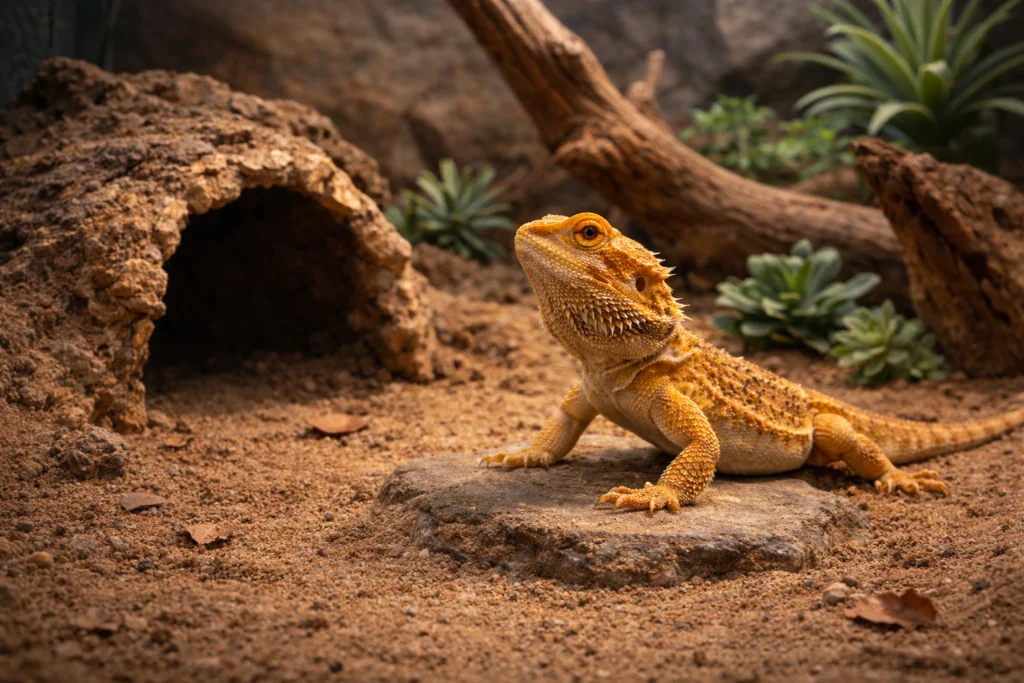
What Substrate Should I Use in My Bearded Dragon Enclosure?. Choosing the best substrate for a bearded dragon enclosure is less about finding a single “perfect” material and more about matching safety, age, and husbandry quality to the animal in front of you. Substrate affects traction, hygiene, humidity stability, feeding behavior, and—under certain conditions—impaction risk.
Solid surfaces such as tile or paper eliminate ingestion concerns entirely. Loose substrates allow digging and more natural texture but introduce variables that must be managed correctly. The right choice depends on the dragon’s age, health status, and how well the enclosure’s lighting and temperature are set up.
Blanket rules like “all sand is dangerous” or “natural is always better” oversimplify a decision that deserves more nuance. A well-set-up enclosure can safely support more than one approach—but only under the right conditions.
This guide breaks down what actually matters so you can choose confidently.
What Makes a Substrate “Best”?
Footing and stability come first. A “best” substrate is the one that supports good hygiene and normal behavior without adding avoidable risk. If your dragon’s back feet slide when they pivot to turn, or the surface flexes under their weight, you’ll often see hesitant movement and less confident basking posture. A stable, grippy surface matters more than most people expect—especially for older adults, heavier dragons, or anyone recovering from illness.
Cleanability determines long-term health. Substrate should allow you to remove waste quickly and thoroughly without disturbing the entire enclosure floor. If spot-cleaning requires lifting or replacing everything each time, maintenance becomes inconsistent, and bacterial buildup follows. A surface that wipes clean or clearly shows soiled areas makes long-term hygiene far easier to manage.
Moisture behavior must stay predictable. Bearded dragons are adapted to dry environments, so the enclosure floor should not stay damp, hold excess humidity, or support mold growth. At the same time, materials that become dusty and airborne when the dragon moves can irritate eyes and airways. The ideal substrate remains dry, stable, and predictable under normal enclosure conditions.
Feeding interaction changes risk. If insects disappear into the substrate, if fine particles cling to wet greens, or if food is routinely taken directly from the floor, the likelihood of swallowing particles increases. That doesn’t automatically make a substrate unsafe—but it does change how it should be used and managed.
Solid Substrates (Safest Baseline Option)
Solid surfaces eliminate ingestion concerns entirely. For many keepers—especially beginners—this makes them the simplest and lowest-risk starting point. Even if a dragon lunges at a cricket and misses, there is nothing loose to swallow along with it. Reducing this variable is especially helpful for young dragons or for anyone concerned about impaction risk.
Ceramic or slate tile is the most durable long-term option. When properly fitted, it provides firm traction and a stable basking surface that holds warmth without shifting under the dragon’s weight. You can usually see the difference in posture right away: the dragon stands planted, shoulders lifted, rather than adjusting constantly to keep balance. Waste is easy to spot and remove, and surfaces are straightforward to clean and maintain over time.
Paper towels or butcher paper work especially well for babies and during medical situations. Young dragons are more erratic feeders and more likely to grab mouthfuls of greens along with whatever is underneath them. A disposable surface allows quick replacement, clearer stool monitoring, and tighter hygiene control during rapid growth phases.
Non-adhesive shelf liner offers a reusable middle ground. It provides traction and can be wiped clean daily, though it should be replaced if it begins to curl, trap debris in textured areas, or retain moisture along the edges.
Reptile carpet is often categorized as a “safe” solid option, but it requires more maintenance than many people expect. Fibers can trap waste and bacteria if not washed thoroughly, and looped material can catch nails. For a deeper breakdown of carpet specifically, see our dedicated reptile carpet guide.
Loose Substrates — When Are They Appropriate?
Loose substrate is where most debate happens. It is also where nuance matters.
Impaction is rarely caused by substrate alone. It typically develops when other aspects of husbandry are not properly managed. A healthy adult dragon with correct heat, strong UVB, and good hydration is often capable of passing small, incidental amounts of particulate material. That does not make loose substrate automatically safe, but it does mean the risk depends heavily on context. For a detailed breakdown of how impaction develops and what to watch for, see our Bearded Dragon Impaction guide.
Age is the first dividing line. Babies and young juveniles are clumsier feeders and more likely to lunge at insects directly off the floor. Their digestive tract diameter is smaller, and they have less margin for error. For this reason, solid substrate is strongly preferred during early growth. With healthy adults, risk becomes more conditional.
Feeding practice changes the equation as well. Crickets that burrow into deep sand increase the likelihood of swallowing substrate during a strike. Finely dusted insects can pick up particles that cling to their bodies. Greens placed directly on loose material collect grit along their edges. Many keepers who choose loose substrate reduce risk by feeding in bowls, using a separate feeding tile, or keeping substrate depth moderate rather than several inches deep.
Texture and particle size also matter. Extremely fine, dusty material that becomes airborne when disturbed can irritate eyes and airways. Coarse, irregular particles can be harsher if swallowed. Well-graded sand and soil blends or packed clay mixes tend to behave more predictably than novelty substrates marketed primarily for appearance.
Loose substrate can be appropriate for healthy adult dragons in properly maintained enclosures. It is not required for good husbandry, and it should not be the starting point for beginners. It is a conditional choice that depends on how well the rest of the enclosure is managed, including proper basking temperatures and a correctly configured UVB lighting setup.
Substrates to Avoid
Calcium sand is the most commonly marketed example. Despite claims that it is “digestible,” it can clump when wet and harden once inside the digestive tract. Some dragons are also drawn to ingest it repeatedly. For these reasons, most experienced keepers and reptile veterinarians discourage its use. If you want a deeper explanation of how ingestion becomes dangerous, the Bearded Dragon Impaction article explains the mechanism in detail.
Ground walnut shell products are another concern. The particles are often irregular and sharper than they appear, which can irritate soft tissue if swallowed and may cause eye irritation if kicked up during movement.
Moisture-retentive substrates such as bark or wood mulch are poorly suited to an arid-adapted species. These materials can hold humidity, support mold growth, and create unstable enclosure conditions over time.
Coconut fiber is sometimes marketed as a natural option, but it can become problematic if kept damp or poorly maintained. When saturated, it may promote mold or bacterial growth. When overly dry and dusty, it can irritate eyes and airways. It requires more environmental control than many beginners anticipate.
Novelty sand mats or adhesive-backed textured surfaces should also be approached cautiously. Any material that traps waste, cannot be thoroughly disinfected, or degrades with repeated cleaning tends to create long-term hygiene challenges. Carpet-style materials are evaluated separately in the Reptile Carpet article.
Bioactive & Naturalistic Setups — Are They Worth It?
Bioactive enclosures aim to recreate a functioning ecosystem inside the tank. Instead of a single surface layer, they use a soil-based substrate, microfauna such as isopods or springtails, and live plants to break down waste and cycle nutrients. When designed correctly, this approach can reduce odor, encourage natural digging behavior, and create a visually appealing enclosure.
That said, bioactive is not automatically “better.” It is more complex. Substrate depth, soil composition, drainage layers, and cleanup crew population all require planning and ongoing monitoring. If the system becomes too damp, compacts excessively, or accumulates waste faster than the microfauna can process it, it stops functioning as intended. What looks natural can quickly become unsanitary if not maintained properly.
For adult dragons with stable husbandry and experienced keepers, bioactive setups can work well. They may support digging behavior and allow more natural movement across varied terrain. However, they are rarely appropriate for babies or for dragons recovering from illness. In those situations, visibility of waste and ease of disinfection are more important than environmental complexity.
It is also important to recognize that bearded dragons do not require a bioactive enclosure to thrive. A clean, stable solid substrate with proper heat and lighting supports their health just as effectively. Environmental stability, including temperature gradients and UVB configuration, remains more important than substrate style, as outlined in the Bearded Dragon Habitat Guide. Bioactive should be viewed as an enrichment choice—not a necessity.
If you choose this route, plan for careful moisture control, appropriate lighting strength, and routine observation of how the substrate behaves under heat. A functioning bioactive enclosure should remain dry at the surface, free of mold, and stable under the dragon’s weight.
Best Substrate by Age — A Clear Starting Point
If you want a simple answer, age is the easiest place to begin.
Babies (0–6 months)
Solid substrate is strongly recommended. Paper towels, butcher paper, or properly fitted tile make feeding easier and eliminate ingestion concerns during a phase when dragons are erratic hunters. Babies often overshoot insects, mouth the ground, and grab greens with force. Keeping the surface simple reduces variables while they grow, especially when you are trying to minimize impaction risk.
Cleanliness is also easier to monitor at this stage. Stool consistency, frequency, and appetite are important health indicators in young dragons. A flat, visible surface makes changes easier to notice quickly.
Juveniles (6–12 months)
Solid substrate remains the safest default. At this stage, dragons are larger and more coordinated, but they are still aggressive feeders. If loose substrate is introduced, it should be done cautiously and only once husbandry fundamentals—heat gradients, UVB strength, hydration, and diet—are well established, as outlined in the Bearded Dragon Habitat Guide.
Many keepers choose to wait until the dragon is fully grown before introducing loose substrate.
Adults (12+ months)
Healthy adults have more digestive margin and more stable feeding behavior. At this point, keepers may choose between solid substrate or a well-managed loose blend based on preference and enclosure design.
The key distinction is this: loose substrate is a conditional option for healthy adults—not a requirement for proper care. A stable, easy-to-clean surface remains a perfectly appropriate lifelong choice.
When in doubt, default to solid substrate. It simplifies management and removes one potential variable from the enclosure.
What Substrate Should I Use? (Quick Decision Guide)
If you are unsure, start with the safest baseline and adjust only if you have a clear reason to change.
If you have a baby (under 6 months):
Use paper towels, butcher paper, or fitted tile. This keeps feeding predictable and removes ingestion concerns during a stage when dragons are clumsy and fast-growing, reducing impaction risk.
If you have a juvenile:
Solid substrate remains the safest default. Consider loose substrate only if husbandry fundamentals—heat gradients, UVB strength, hydration, and diet—are already stable and you are comfortable monitoring behavior and feeding closely, as outlined in the Bearded Dragon Habitat Guide.
If you have a healthy adult:
You may choose between solid substrate and a well-managed loose blend. Solid surfaces are easier to clean and monitor. Loose blends can support digging behavior but require more oversight and careful feeding practices.
If your dragon is sick, underweight, or recovering:
Return to solid, easily disinfected substrate. Visibility and sanitation take priority over enrichment during recovery.
If you want the simplest long-term option:
Tile is the most durable and predictable choice. It provides stable footing, easy cleaning, and consistent performance under heat.
Substrate is rarely the defining factor in a dragon’s health. Proper heat gradients and correctly configured UVB lighting matter more. Choose a surface that you can maintain consistently, that stays dry and stable, and that fits your experience level.