
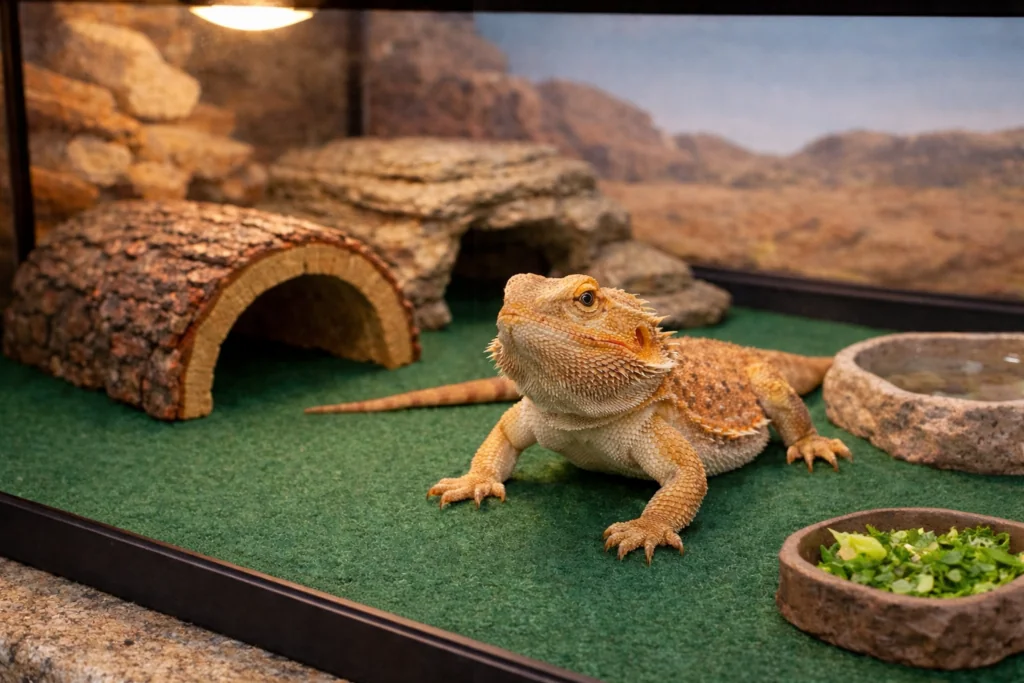
Reptile Carpet – Expert Guide. Reptile carpet is one of the most commonly recommended substrates for bearded dragons—especially for new keepers. It’s often marketed as safe, easy to clean, and ideal for beginners. Walk into almost any pet store, and you’ll likely see it positioned as the default choice.
But among experienced keepers and veterinarians, reptile carpet is far more debated.
While it avoids some of the concerns associated with loose substrates, reptile carpet introduces its own set of issues that aren’t always obvious at first. Many of these problems develop gradually, over weeks or months of use, when a setup that still looks clean may no longer be truly sanitary.
This article explains where reptile carpet works, where it tends to cause problems, and how those tradeoffs play out in real bearded dragon enclosures.
What Is Reptile Carpet?
If you’ve ever set up a bearded dragon enclosure using a starter kit, there’s a good chance reptile carpet came with it—or was recommended alongside it. It looks tidy, fits neatly into the tank, and promises a simple alternative to sand or soil.
Physically, reptile carpet is exactly what it sounds like: a fabric mat meant to sit on the enclosure floor. It’s usually made from dense, felt-like synthetic fibers and sold in flat sheets that you cut to size. Once it’s in place, it doesn’t shift much, it stays under furniture easily, and at first glance it does what it claims to do.
That surface—solid, uniform, and visually “clean”—is a big part of its appeal. Because it isn’t loose and doesn’t resemble traditional substrate, reptile carpet is often framed as the safer, more controlled option, especially for new keepers. It feels orderly. It feels manageable. And for the first few weeks, it usually behaves that way.
What’s harder to see early on is how that same surface holds up once heat, waste, moisture, and daily use are part of the equation.
Why Reptile Carpet Is Often Recommended
Reptile carpet is often recommended because it feels like a safe middle ground. It isn’t loose, it doesn’t resemble sand or soil, and it avoids the immediate fear of ingestion that many new keepers have when setting up an enclosure for the first time.
Pet stores lean on it for similar reasons. It’s easy to stock, easy to explain, and easy to bundle with starter kits. There’s no measuring, no mixing, and no real judgment call involved—just cut it to size and place it in the tank.
For new keepers especially, reptile carpet offers a sense of control. It looks clean, stays put under furniture, and gives the impression that potential problems have been “designed out” of the setup. That simplicity is reassuring early on, even if it doesn’t tell the full story over time.
The Real Problems With Reptile Carpet
Most of the problems with reptile carpet don’t show up immediately. Early on, it often looks clean and works more or less as advertised. Over time, however, the same fabric qualities that make it appealing at first begin to create real drawbacks.
Hygiene and Bacteria Build-Up

Reptile carpet is made from dense, fibrous material, and those fibers trap more than just visible debris. Waste, moisture, shed skin, and food residue can settle below the surface, where they’re difficult to remove through routine cleaning. Even when the carpet looks clean, bacteria can persist within the fibers.
This creates a gap between appearance and sanitation. Warm areas under hides or near water bowls are especially prone to staying damp, which can allow bacteria to linger or regrow between cleanings. Over time, maintaining truly sanitary conditions becomes harder than it initially seems.
Nail, Toe, and Mouth Injuries
As reptile carpet wears, the fibers can flatten, loosen, or fray. Claws may catch during normal movement, climbing, or quick turns. This can lead to broken nails, minor toe injuries, or irritation around the mouth if a dragon bites or grips the surface while feeding.
These issues tend to develop gradually, which is why they’re often overlooked early on. The risk usually increases with age and repeated washing, rather than appearing as an immediate problem.
Wear, Fraying, and Maintenance Reality
Keeping reptile carpet reasonably clean requires frequent removal, thorough washing, and complete drying. Heat, UV exposure, and repeated cleaning cycles accelerate wear, shortening the usable lifespan of the material.
As a result, reptile carpet often needs to be replaced more frequently than expected. What starts as a simple, reusable solution can quietly turn into a cycle of constant cleaning and periodic replacement—reducing the convenience that made it appealing in the first place.
Is Reptile Carpet Ever a Good Choice?
In limited situations, reptile carpet can make sense—but usually as a short-term solution rather than a permanent one. Temporary setups, such as quarantine enclosures or brief holding tanks, are the most common examples. In these cases, the goal is often easy monitoring and quick cleanup, not long-term durability.
Even then, reptile carpet works best only if it’s treated as disposable or rotated frequently. That means regular removal, thorough cleaning, and close inspection for wear or fraying. Once the fibers start to break down, the risks increase quickly.
For many keepers, simpler options end up working better in these scenarios. Disposable liners or other easily replaced surfaces are often easier to keep truly clean and don’t carry the same long-term wear issues. In practice, reptile carpet tends to be acceptable only when its limitations are clearly understood—and when it’s not expected to perform beyond that narrow role.
Better Substrate Options to Consider
If the goal is long-term cleanliness and lower maintenance, non-porous surfaces are often a more reliable starting point. Solid options like tile or sealed enclosure liners don’t trap moisture or debris below the surface, which makes routine cleaning more straightforward and predictable. When waste is removed, it’s actually gone—there’s no fabric layer underneath holding onto residue.
For a broader comparison of substrate types and how they fit into a complete enclosure design, see the Bearded Dragon Habitat — Expert Guide.
Some keepers also move toward more naturalistic substrates once husbandry fundamentals are solid. When chosen carefully and paired with appropriate feeding practices, modern soil-based mixes can support natural behaviors without introducing the problems associated with older, dusty, or calcium-based sands. These setups require more planning, but they avoid many of the hidden hygiene and wear issues seen with carpet.
Ultimately, substrate choice works best when it matches how the enclosure is used day to day. How food is offered, how often the habitat is cleaned, and how much wear the surface sees all matter more than whether the substrate looks “beginner-friendly” on the shelf.
So… Should You Use Reptile Carpet?
Reptile carpet exists because it solves a very specific beginner problem: fear. It looks clean, feels controlled, and promises to remove a whole category of mistakes from the equation. Early on, that reassurance can be appealing.
But once you look past first impressions, reptile carpet rarely earns its keep. It demands more cleaning than expected, wears out faster than advertised, and introduces hygiene and injury risks that are easy to underestimate until they show up firsthand. For something marketed as simple, it ends up being surprisingly high-maintenance.
Most experienced keepers move away from carpet not because it’s catastrophic, but because better options make daily care easier and more predictable. Non-porous surfaces and well-chosen natural substrates age better, clean more reliably, and don’t depend on constant vigilance to stay safe.