
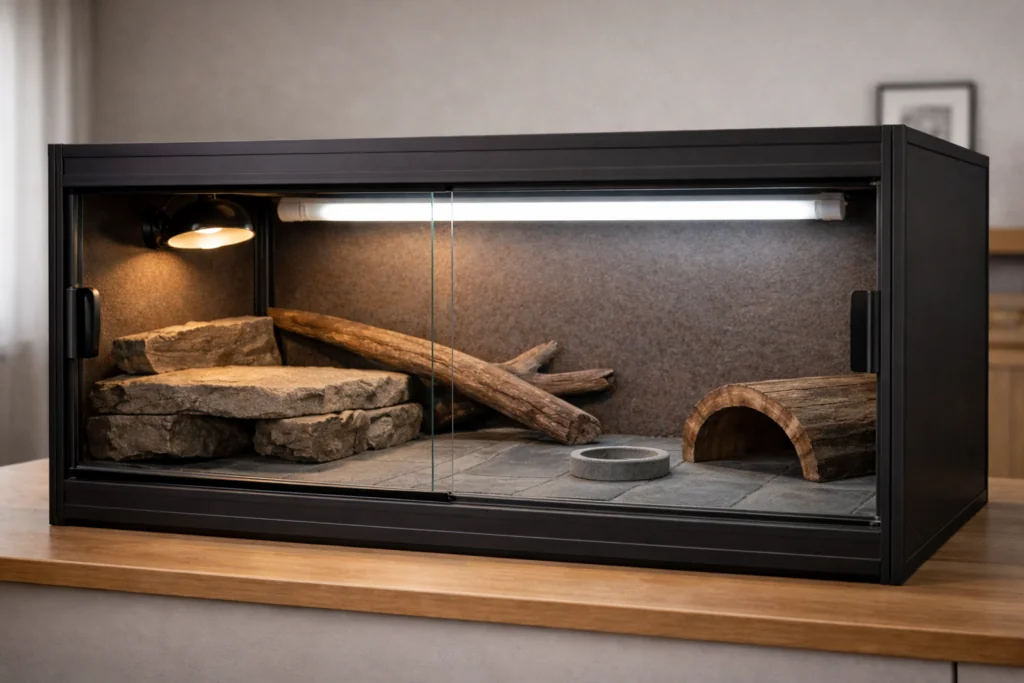
Best Bearded Dragon Tank: Size, Budget & Top Picks. A bearded dragon tank isn’t just a container with the right dimensions. It needs to support a usable layout where heat, UVB lighting, and open space work together, allowing the dragon to move between basking and cooler areas throughout the day.
Many enclosures look similar on paper but behave very differently once they are set up. Limited floor space, poor access, or incompatible lighting placement can make it difficult to maintain stable temperature zones or position UVB correctly. These limitations often don’t become obvious until after the enclosure is in use, which is why many setups end up being replaced sooner than expected.
If you haven’t reviewed enclosure sizing yet, it helps to understand the current baseline before choosing a tank. From there, the focus shifts to selecting an enclosure that supports a functional layout, fits your space, and avoids the common constraints that lead to early upgrades.
What Makes a Good Bearded Dragon Tank?
A bearded dragon tank is defined less by how it looks and more by how well it works once everything is in place. The enclosure has to support a layout where heat, lighting, and open space function together without forcing everything into a single area.
Floor space is the foundation, but usable space matters just as much. Basking platforms, branches, and food dishes reduce the open area, so a tank that looks large on paper can feel much smaller once it’s set up.
Access also affects how the enclosure is used day to day. Front-opening designs make feeding, cleaning, and repositioning décor easier and less disruptive, especially once lighting is installed. Top-opening tanks can still work, but they often become harder to manage.
Lighting and heat compatibility is one of the more common limitations. UVB fixtures and basking lamps need to overlap correctly without being blocked or forced into awkward positions. Ventilation also plays a role, as airflow affects how heat is retained and how stable the enclosure remains throughout the day.
Best Tank Size for Bearded Dragons
The current baseline for an adult bearded dragon is an enclosure measuring 4 feet long by 2 feet wide by 2 feet tall. This footprint allows enough space to create a defined basking area, a cooler side, and room to move between them.
Gallon ratings are often used to describe tank size, but they can be misleading. What matters is the actual floor dimensions and how much usable space remains once the enclosure is set up. For a more complete breakdown of how enclosure size affects layout and temperature zones, see the Bearded Dragon Tank Size Guide.
Types of Bearded Dragon Tanks

PVC Enclosures
PVC enclosures are widely used because they hold heat well and are designed with reptile setups in mind. They typically include front-opening doors and solid tops that make it easier to position lighting correctly. This makes them one of the most reliable options for maintaining stable conditions with less adjustment. The main drawback is cost, but they tend to provide the most consistent and flexible setup once everything is installed.
Glass Tanks
Glass tanks are common and easy to find, especially for beginners. They offer clear visibility and can work when sized appropriately, but they lose heat more quickly and usually rely on top-mounted lighting. This can make it harder to position UVB and basking lamps precisely compared to enclosed designs, often requiring additional adjustments to get both heat and lighting aligned.
Wood or Custom Enclosures
Wood and custom-built enclosures offer strong heat retention and flexibility in size and layout. They can be designed to fit specific spaces or more advanced setups, but quality varies depending on construction, and they require more effort to build or source.
Screen or Mesh Enclosures
Screen enclosures provide maximum airflow but are rarely ideal for indoor bearded dragon setups. Heat and UVB are harder to control, and maintaining stable conditions often requires additional adjustments.
Best Bearded Dragon Tanks by Budget
Cost affects what type of enclosure you can realistically choose, but the differences are less about size and more about how easily the setup works once everything is in place. Spending more doesn’t change the basic requirements—it reduces the number of compromises needed to meet them.
Budget Options
Lower-cost setups are usually glass tanks or basic enclosures that meet the minimum size requirement. They can work, but often require more adjustment to manage heat and lighting effectively. Many setups in this range rely on top-mounted fixtures, which can limit how precisely basking and UVB lighting are positioned.
Mid-Range Options
Mid-range enclosures are often purpose-built for reptiles and provide a better balance between cost and usability. Front-opening access, more consistent heat retention, and improved lighting compatibility make them easier to set up and maintain without constant adjustment.
Premium Setups
Higher-end enclosures prioritize flexibility and long-term stability. They typically offer the most control over layout, lighting placement, and heat retention, making it easier to maintain consistent conditions over time. While the upfront cost is higher, they often reduce the need for future upgrades.
Tank Setup Considerations Before You Buy
Before choosing a tank, it helps to think through how the enclosure will actually be set up. Lighting placement is one of the most common constraints. UVB fixtures and basking lamps need to overlap correctly, and not every enclosure makes that easy—especially those with fixed tops or limited mounting options.
Interior space can also become more limited than expected. Basking platforms, hides, and climbing structures take up room, and a layout that looks workable on paper may feel crowded once everything is in place.
Clearance above the tank is another factor that’s often overlooked. Heat lamps and UVB fixtures need enough space to be positioned safely and adjusted over time.
Thinking through these constraints before buying helps avoid setups that require constant adjustment or early replacement.
Common Tank Buying Mistakes
One of the most common mistakes is choosing an enclosure that meets a gallon label but not the space needed for a functional layout. Tanks that appear large enough can still fall short once lighting and décor are in place.
Undersized enclosures are still frequently recommended in older guides and retail setups. They often make it difficult to arrange heat and lighting correctly and rarely support a stable setup.
Tall tanks instead of long ones are another issue. Extra height doesn’t replace the horizontal space needed to create a usable temperature gradient.
Starter kits can also be misleading. They often bundle smaller enclosures with basic equipment, which can make it harder to build a proper setup from the start.
Ignoring lighting constraints is a more subtle problem. Tanks that make it difficult to position UVB and basking lamps correctly can require ongoing adjustment.
Top Bearded Dragon Tank Picks
If you’ve worked through the differences in tank types, budget, and setup constraints, the remaining step is choosing an enclosure that fits those criteria without unnecessary tradeoffs. A few well-designed options tend to stand out because they make lighting placement, heat management, and daily use more straightforward.
Best Overall
A standard 4×2×2 PVC enclosure with front-opening doors and a solid top offers the most balanced setup. It supports consistent heat retention, allows flexible lighting placement, and is easier to manage day to day. This type of enclosure—commonly available from brands like Zen Habitats or Dubia—works well for most keepers and avoids many of the limitations found in simpler setups.
Best Budget
A properly sized glass tank can work as an entry-level option if the layout is carefully planned. Expect to spend more time dialing in lighting placement and heat management, but it can provide a functional setup when space and budget are limited. Large aquariums in the 4-foot range are typically available through pet retailers like Petco or PetSmart, as well as secondhand markets.
Best Premium
Higher-end PVC or custom enclosures offer the most flexibility for layout and long-term stability. Options from brands like Kages or Custom Reptile Habitats are often designed with mounting, insulation, and access in mind, making it easier to maintain consistent conditions over time, especially in more complex setups.
Frequently Asked Questions
Is a 40 gallon tank enough for a bearded dragon?
No. That recommendation still shows up in older guides, but a 40 gallon tank doesn’t provide enough space to set up heat and lighting properly.
Are glass tanks bad for bearded dragons?
Not necessarily—but they tend to be less forgiving. Heat escapes more easily, and top-mounted lighting can make UVB and basking placement harder to dial in.
What is the best tank for a beginner?
A 4×2×2 enclosure with front-opening access is the most straightforward option. It gives you enough space to set things up correctly without needing to upgrade a few months later. See the Bearded Dragon Tank Size Guide for sizing details.
Do baby bearded dragons need smaller tanks?
No. The idea that large enclosures “stress them out” comes up often, but it doesn’t hold up in practice when the setup is arranged properly.