
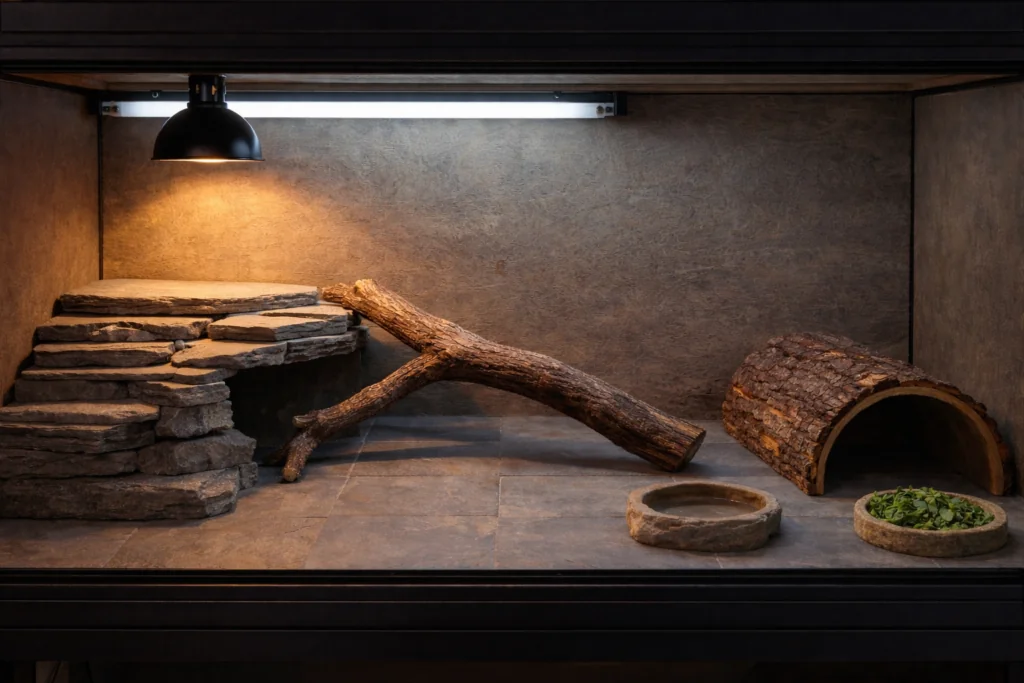
Bearded Dragon Habitat — Expert Guide. A bearded dragon’s habitat is not just a container—it is the system that governs how the animal actually functions day to day. Temperature, light, space, and layout determine how effectively a dragon can regulate its body temperature, digest food, absorb calcium, and manage stress. When those elements are even slightly off, the effects tend to show up slowly: stalled growth, low activity, inconsistent appetite, or subtle behavioral changes that are easy to dismiss early on.
This is why habitat problems are so often misunderstood. Poor growth, weak bones, lethargy, or appetite issues are frequently blamed on diet or supplementation, when the real cause is environmental. In practice, feeding changes rarely fix those problems on their own. A well-designed habitat does most of the work in the background. When it doesn’t, no amount of adjustment elsewhere fully makes up for it.
This guide is meant to serve as a foundation. It focuses on how the core pieces of a bearded dragon habitat work together, and why each one matters. The individual components—enclosure size, heat, UVB lighting, substrate, and layout—are covered at a high level here, with deeper guides available for each. Getting the habitat right first makes every other part of care simpler, more predictable, and more successful over time.
Why Proper Habitat Matters

A bearded dragon does not experience its enclosure as a collection of separate components. Heat, UVB, space, and layout are used together, often at the same time, as the animal moves through the habitat. A basking spot that reaches the right temperature but lacks usable UVB is incomplete. Likewise, strong lighting without adequate space or escape options can create chronic stress rather than benefit.
When these elements are aligned, the enclosure quietly supports normal behavior. The dragon chooses where to warm up, where to cool down, and when to disengage, without constant intervention from the keeper. When they are not, problems tend to surface indirectly—through behavior, appetite, or long-term health—rather than as a single obvious failure.
Enclosure Size and Orientation
Choosing an enclosure is one of the earliest—and most consequential—habitat decisions an owner makes. Size and layout determine whether a bearded dragon can move normally, establish temperature gradients, and avoid constant low-level stress. While décor and lighting often get more attention, enclosure dimensions quietly set the ceiling for how well everything else can work.
Minimum Enclosure Size by Age
Young bearded dragons are often started in smaller enclosures for practical reasons, but these setups should be treated as temporary. Growth happens quickly, and space that feels adequate for a juvenile becomes restrictive sooner than many owners expect. An adult enclosure needs enough room for full-body movement, proper heat gradients, and separation between basking and cooler areas. For adult bearded dragons, a minimum enclosure size of 4 feet long by 2 feet wide by 2 feet tall (120×60×60 cm) is now considered the baseline standard for long-term housing. Delaying that upgrade commonly leads to cramped layouts where temperature and lighting compromises become unavoidable.
Floor Space, Height, and Access Design
Bearded dragons are primarily ground-dwelling lizards, which makes usable floor space far more important than vertical height alone. Width and depth allow for natural movement patterns, while modest height supports climbing and proper basking placement. Access design matters as well. Front-opening enclosures tend to reduce stress during routine interaction and maintenance, whereas top-opening designs can trigger defensive responses over time.
Heat and Temperature Gradient

Heat is where a lot of otherwise solid bearded dragon setups quietly go wrong. Not because owners ignore it, but because it’s often reduced to hitting a number instead of thinking about how the animal actually uses warmth throughout the day. Bearded dragons don’t regulate themselves by staying put. They move back and forth, warming up, cooling down, and repeating that cycle constantly.
Basking Heat and Ambient Temperatures
A usable basking area matters more than any single temperature reading. Heat should come from above, creating a clear place where the dragon can warm up intentionally. That same heat warms the surface the dragon rests on, which supports digestion and normal activity while it’s basking. If you want the exact temperature targets by age and enclosure size, see the Bearded Dragon Basking Temperature Guide.
Trouble tends to show up when everything in the enclosure sits at roughly the same temperature. In those setups, dragons often look “off” long before anything looks obviously wrong. Heat sources that provide constant warmth from below rarely solve this and often make self-regulation harder.
Establishing and Measuring a Thermal Gradient
A healthy enclosure gives the dragon options. There should be a noticeable difference between the warm end and the cooler end, with room in between for adjustment. Measuring temperatures accurately means paying attention to both air and surface temperatures, especially at the basking spot.
UVB Lighting Fundamentals
UVB is one of the easiest parts of a bearded dragon setup to get wrong without realizing it. Many enclosures look fine at a glance—bright lights, active dragons, normal feeding—yet still fall short in ways that don’t show up right away.
UVB Output Decline and Replacement
UVB bulbs rarely fail in obvious ways. They continue producing visible light long after usable UV output has dropped. This makes aging bulbs one of the most common hidden causes of long-term health issues.
UVB and Long-Term Health
Bearded dragons rely on UVB exposure to produce vitamin D₃ and use calcium properly. When UVB levels drift out of range, the effects are often subtle at first—reduced energy, slower growth, or changes in posture that are easy to dismiss.
Choosing and Positioning UVB Lighting
UVB works best when it overlaps naturally with basking behavior. Linear-style fixtures that spread UVB across usable space tend to provide more consistent exposure than narrow or poorly placed sources.
For specific bulb recommendations, mounting guidance, reflector considerations, and safe distance ranges, see the Bearded Dragon UVB Setup — Fixtures, Bulbs, and Safe Distances guide.
Substrate Options and Safety
Substrate issues rarely exist on their own. Problems usually appear when loose substrate is added to enclosures that already struggle with heat, hydration, or feeding consistency. If you’re trying to decide what to use on the enclosure floor, the Bearded Dragon Substrate Guide walks through the safest options and when different materials make sense.
Solid Substrate Options
Solid substrates remove variables. Tile, liners, and paper-based options are easy to clean and make it obvious when something is off. Many experienced keepers stick with them simply because they’re predictable.
Loose Substrate Considerations (Advanced Keepers)
Loose substrates tend to work best in well-established enclosures with consistent basking, hydration, and feeding habits. In weaker setups, they amplify existing problems rather than adding enrichment. If you’re unsure how substrate, hydration, and basking heat interact, review the Bearded Dragon Impaction Guide before switching to loose materials.
Substrates to Avoid
Calcium sands, crushed walnut shells, and fibrous mats like reptile carpet consistently cause issues. They encourage ingestion, trap waste, or break down in ways that are difficult to clean thoroughly.
Habitat Layout and Furnishings
Layout problems often show up as behavior issues rather than equipment failures. A setup can look complete and still fail to support how the dragon actually uses the space.
Basking Platforms and Vertical Use of Space
Basking platforms need to feel stable. Flat, secure surfaces are used far more consistently than narrow or shifting décor. Vertical space is only useful when it provides safe, accessible landing areas.
Hides, Security, and Visual Stress
Hides allow dragons to disengage without disappearing entirely. Breaking up sightlines and reducing constant exposure often changes behavior more than temperature adjustments.
Humidity and Ventilation
Humidity issues usually come from trapped air rather than dry conditions. Stuck shed, fogged glass, or clicking sounds while breathing often point to poor airflow.
Humidity and Airflow Basics
Mesh tops, functional side vents, and space above the enclosure help prevent stale, damp air. If an enclosure stays wet long after lights come on, airflow is usually the real problem. For specific humidity ranges, measurement placement, and adjustment strategies, see our detailed guide on ideal humidity for bearded dragons.
Bathing can sometimes help clean a dragon or encourage drinking, but it does not replace proper airflow or enclosure conditions. If you’re unsure when baths are actually helpful or how to do them safely, see Do Bearded Dragons Need Baths? How Do I Bathe My Bearded Dragon?.
Day–Night Lighting Cycle
Sleep issues are more often caused by light than temperature. Dragons that pace at night or sleep pressed against the glass are usually reacting to disrupted darkness.
Photoperiod and Nighttime Heating
Bearded dragons need true darkness at night. Colored night bulbs interfere with sleep and should be avoided. When nighttime heat is required, ceramic heat emitters (CHEs) or deep heat projectors (DHPs) provide warmth without visible light.
In many homes, supplemental night heat isn’t necessary if temperatures remain above roughly 65°F (18°C). Additional heating should be used only when nighttime temperatures consistently drop below that range.
Common Habitat Mistakes
- Starting with a juvenile enclosure and never upgrading. This leads to cramped layouts and poor gradients.
- Using red or blue night bulbs. These disrupt sleep more than most owners realize.
- Running UVB that doesn’t overlap the basking area. Placement matters as much as equipment.
- Adding loose substrate too early. Especially when feeding and basking behavior aren’t stable.
- Blocking airflow with solid lids or décor. Moisture buildup often follows.
- Assuming inactivity is normal. It’s often a sign the habitat isn’t working.
Habitat as the Foundation for Long-Term Health
If a bearded dragon setup is doing its job, you usually don’t spend much time troubleshooting it. The dragon eats consistently, uses the basking area without hesitation, sheds cleanly, and doesn’t pace the glass every evening.
When problems persist, adjusting food or supplements rarely fixes them for long. Stepping back and correcting the enclosure itself—space, heat, light, and airflow—almost always has a bigger impact. Once the habitat is right, the rest of care becomes simpler, not more complicated.